
Oxford Township Previous Residents by Era
Oxford Township address history uses layers that answer different questions. The Butler County Auditor supplies the current parcel starting point. The Recorder follows recorded parties and legal descriptions. Probate can add estate and real-estate-sale context. Lane collections, federal census schedules, local newspapers, and historic atlases add dated household or place evidence. None of these sources is a complete list of past residents, and none should be forced to answer a question beyond its record date or custody.
| Source | Years It Covers | Where Held | What It Shows |
|---|---|---|---|
| Butler County Auditor parcel record | Current record, subject to portal date | Butler County Auditor Property Search | Parcel starting point, current owner trail, and legal-description route |
| Recorder official-record search | Site certified through 08/27/2026; earliest online start not published | Butler County Recorder online and counter | Recorded grantors, grantees, instruments, and legal descriptions |
| Recorder legacy and older deed route | Legacy 1987–present; some 1930s–1940s deeds book/page indexed | Recorder Cloud or legacy search and counter | Historic document and book/page trail |
| Probate historic docket indexes | Guardians from 1847; will deposits from 1883; estate dockets from 1920 | Butler County Probate filing office | Estate, guardian, decedent, and will-deposit leads |
| Local directories and federal census | Exact local directory years unconfirmed; decennial released schedules | Lane collections and National Archives routes | Dated listed household and census context |
| Butler County historic atlases | 1875 and 1895 | Ohio History Connection | Landowner and historic geography context |
For a recent transfer, begin with the parcel and Recorder. For a household question between transfers, use the directory, census, newspaper, or obituary layer. For a rural or early Oxford Township location, preserve the legal description and map context. Modern street numbers, City of Oxford boundaries, and a rural-route description can all fail to match one another without that extra record trail.
Trace Oxford Township Previous Residents Through Deeds
Recorded ownership is the backbone of an Oxford Township address trail, although ownership and occupancy are not the same fact. Use the Auditor’s address route to find the current parcel, then keep the parcel number, legal description, situs, current-source date, and owner formatting. The Recorder’s advanced form separates grantor and grantee searches and includes date, book, page, document-number, and legal-description controls. It is a recorded-instrument index, not an address-by-address record of everyone who lived in a home.
- Start with the current parcel, legal description, and situs address in the Auditor record. Save the source date with those details.
- Search the apparent current buyer or owner as a grantee in the Recorder, narrowing by a known purchase period when possible.
- Read the recorded instrument for the prior grantor, the document or book and page reference, and the legal description.
- Search that prior grantor as a grantee to locate the earlier acquisition, using party variants and legal-description fields for trusts, estates, joint owners, or changed names.
- When the online result is incomplete, take the parcel, legal description, document number, and book/page to the Recorder counter. Then layer directories, census, probate, and newspaper evidence between deed transfers.
- Grantor
- The party transferring an interest in a recorded instrument, often the seller in a deed.
- Grantee
- The party receiving an interest in a recorded instrument, often the buyer in a deed.
- Chain of title
- The sequence of recorded transfers used to follow ownership of the same parcel backward in time.
- Legal description
- The recorded land identifier, such as lot, subdivision, condominium, or township description, that can outlast a changed street address.
The Butler County Recorder office page provides the official starting point for the Recorder’s current and legacy search routes.
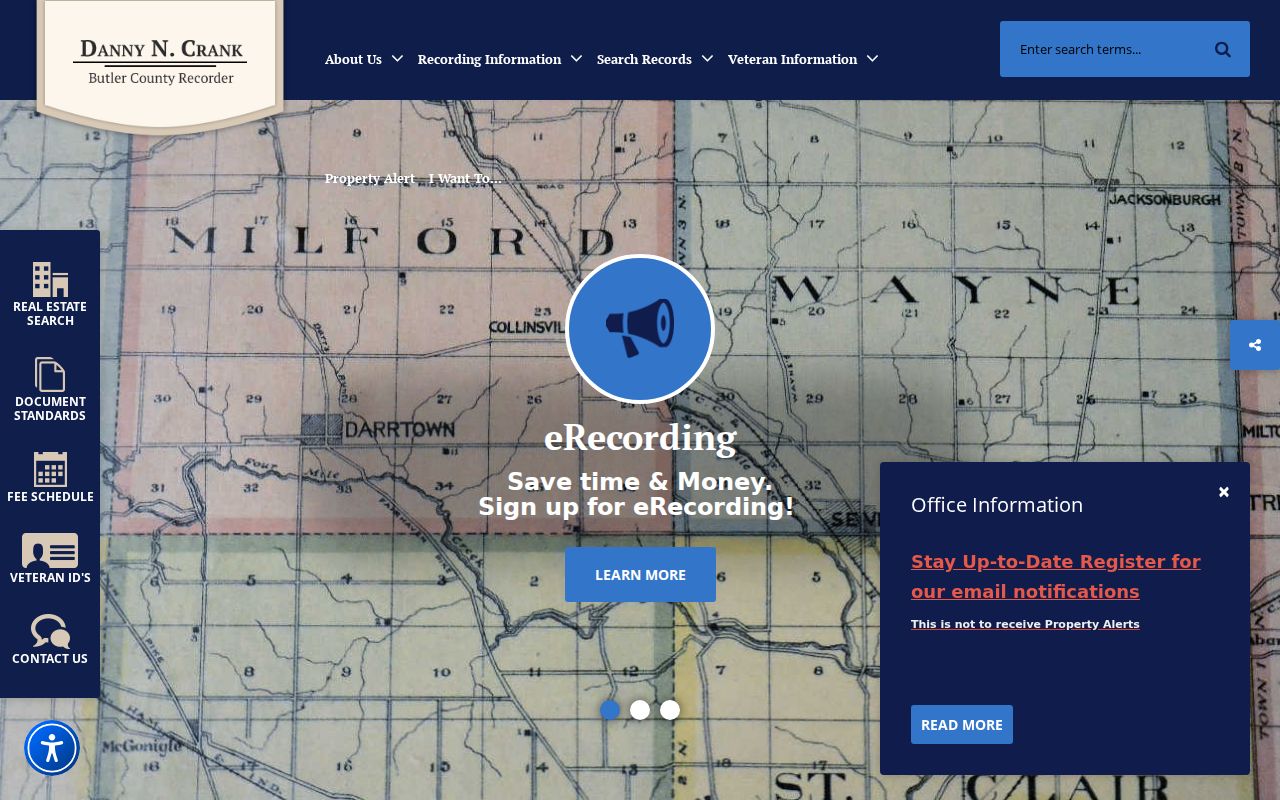
The Recorder view supports a document trail, while the actual instrument or a certified copy is the place to verify a candidate transfer.
Oxford Township Deeds With Book and Page
Older Oxford Township property research needs a book-and-page fallback. The Recorder’s Cloud Search guide says the legacy system covers 1987 to present and shares images and data with Cloud Search. It also notes that deeds from the 1930s and 1940s were imported but may be indexed only by book and page. That does not mean the deed is absent. It means a modern street or party search may not surface the next link without using the legal description, document reference, OCR, or counter assistance.
Recorder advanced search permits party, grantor, grantee, date, book, page, full-text OCR, and City, subdivision, township, or condominium legal controls. OCR can be a clue when an address appears inside a document, but it cannot replace reading the instrument. An address hit might refer to a prior party, notice, tax address, or nearby parcel. Keep the book, page, recording date, party roles, and legal description together before deciding that two records describe the same Oxford Township property.
Note: The Recorder’s certification date indicates current indexing status, not the earliest year searchable online or a guarantee of a structured historic address index.
Oxford Township Previous Residents in Probate Indexes
Probate records can extend an Oxford Township house trail where a recorded owner died, an estate sold real estate, or a guardian was involved. Butler County Probate’s historical docket guide identifies estate administration and executor dockets from November 1920 onward, Real Estate Record books from April 1927 through August 1998, a General Index to Guardians beginning in May 1847, a General Index to Decedents’ Estates beginning in August 1947, and will-deposit receipt indexes beginning in 1883. These are filing-office and counter leads, not a promise that every historical entry is available through a public online form.
The Court’s current notice says that the historic courthouse fire has moved Probate operations temporarily to the Government Services Center, 315 High St., Hamilton, until further notice. Recheck the Court’s current location and hours before a visit. Electronic case information may be delayed or altered, and the Court directs people who need verified information to request it or inspect records in regular hours. Adoption, commitment, and other confidential files have separate limits and do not belong in an address-history search.
Butler County Probate Court’s record-search page is the official online route, with the docket-book guide and filing office providing the historical fallback.
Oxford Township Previous Residents at Smith Library
Lane Libraries offers a documented property-history research service, which makes it a practical human-use route when deed records identify a parcel but not the people historically listed there. Send Smith or the local-history service the address, any alternate historic address or rural-route wording, parcel or legal description if known, target years, and names already found. Ask the librarian to identify the directories, maps, tax material, newspapers, and photograph files actually available for the question.
Smith Library and the Cummins Local History Room hold the local-history material behind this work. Lane describes collections of paper records, maps, historical newspapers, photographs, books, directories, and yearbooks. That material can help build a history of an address without assuming that every person in a directory was the recorded owner, or that every deed party lived at the property. The useful result is a dated trail with sources, not an unsupported list of previous residents.
Lane Libraries’ Local History & Genealogy service documents the property-history and obituary or newspaper research route.
Oxford Township Past Households in Directories
Past households require a second trail alongside ownership. Lane catalog results establish a Dickman Hamilton-Oxford criss-cross series with a catalog publication range of 1980–9999, but the actual annual volumes at Smith have not been confirmed. A criss-cross issue, when a relevant local issue is held, can arrange listings by address. A standard city directory may arrange them by name. Ask staff for the precise year, item location, whether the volume may be scanned, and whether it carries an abbreviation key before relying on its content.
- Choose a directory year close to the transfer date, and request one issue before and after if Lane confirms the volumes.
- Transcribe the exact name, address wording, and page or image reference from the chosen issue. Do not assume a field or abbreviation that has not been inspected.
- Use a reverse or criss-cross volume only when the relevant local issue is confirmed, and keep its year separate from the name directory’s year.
- Pair the dated listing with the federal census release nearest the period. Census schedules from 1850 onward name household members, while earlier schedules generally name only the head.
- Test the household evidence against the parcel, deed, probate, obituary, and newspaper trail, retaining conflicts instead of forcing a match.
The Dickman criss-cross catalog result identifies the Hamilton-Oxford series, not a verified complete shelf run.
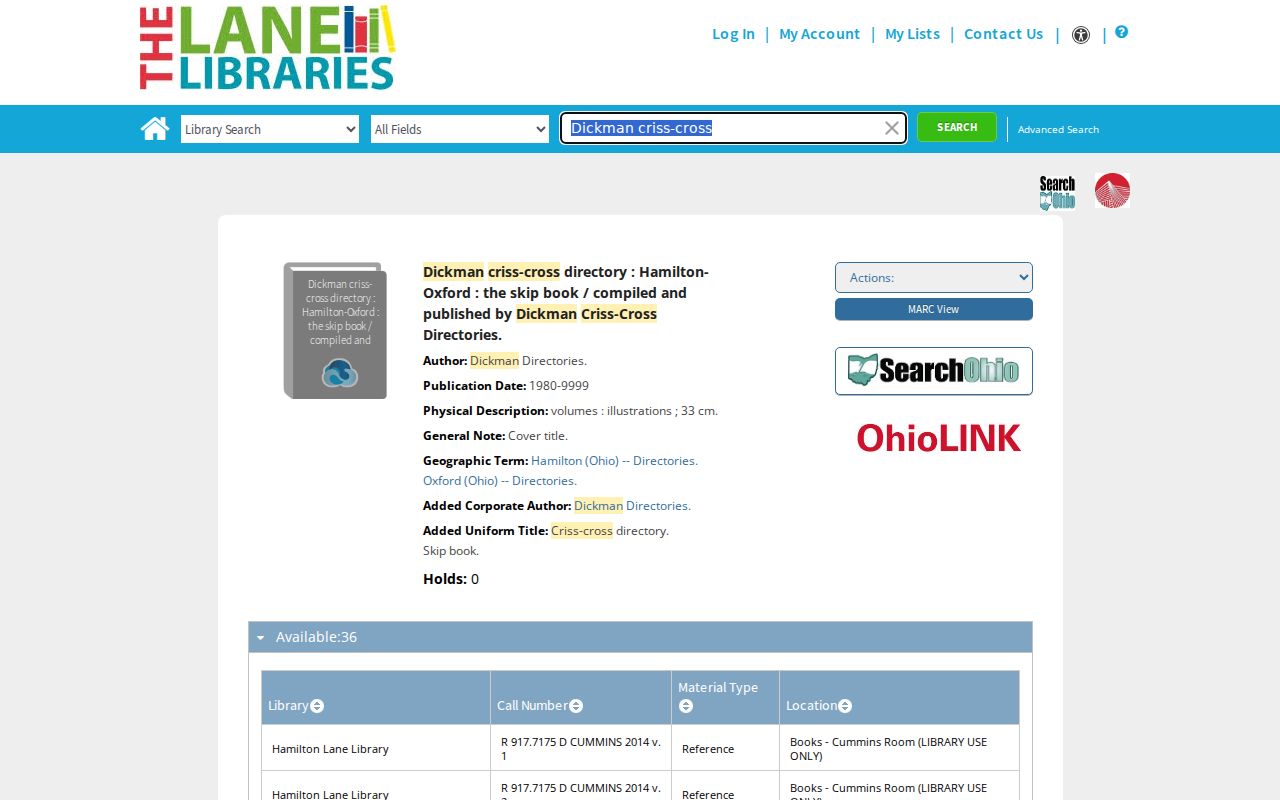
The catalog result can guide a staff request for an address-year volume, while the selected printed issue supplies the only reliable details to transcribe.
Oxford Township Previous Residents in Census Records
Federal census schedules are a time-stamped household layer, not a continuous address ledger. The National Archives describes released decennial census records, and the 1950 census was the current public census release at the time of the research. Use the directory date to place an Oxford Township household between census enumerations. A difference between records can reflect the census date, a move, an alternate name, a student or boarder arrangement, or a directory omission. It should not be resolved by guessing.
National Archives census research explains the federal schedule route that pairs with local directory and deed work.
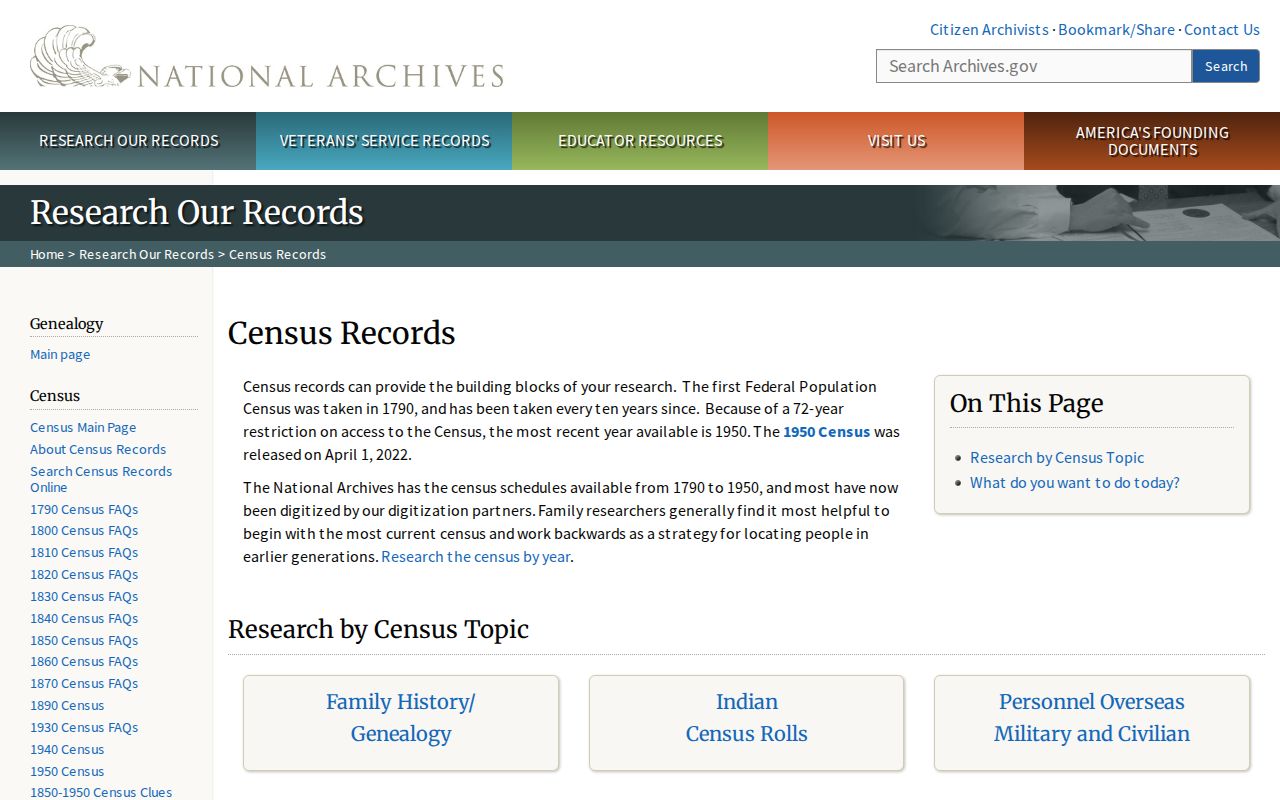
The census screen represents an archival household source. Its entries need to be cited with the enumeration date and evaluated beside local address evidence.
Oxford Township Previous Residents on Historic Atlases
Historic atlases are the geography layer for rural Oxford Township property trails. Ohio History Connection verifies Everts’ Combination Atlas Map of Butler County from 1875 and Rerick Brothers’ The County of Butler County Ohio from 1895. They can place a landowner name, historic road, township area, or map context beside the legal description carried from a deed. An atlas is not an address-level directory, and its label should not be converted into proof that a particular household lived at the parcel.
Ohio History Connection’s historic-atlas page provides the verified Butler County atlas route. Inspect the original map for its legend, edition, and coverage before citing a lot or owner. A legal description, plat, book and page, and map label often work together where one historic street-number search fails.
Oxford Township Previous Residents and City Limits
Oxford Township is not the same geography as the City of Oxford. The township includes the City of Oxford, a College Corner portion, and an unincorporated remainder. That makes the boundary part of any address history. City GIS, annexation maps, and City permit material can be useful only after confirming that the parcel was within City jurisdiction in the relevant period. The City’s permit platform change in May 2026 is a City-only access change, not a countywide or township-wide historic record system.
For an unincorporated Oxford Township parcel, return to the County Auditor, Recorder, County mapping, and the appropriate county permit or request channel. A boundary or annexation change can explain why an address appears in a City record at one time and not another. It does not replace a title search, and it does not establish who lived at the property. Preserve the legal description when city, township, rural-route, or street terms point in different directions.
Note: City permits and City mapping can provide dated context for a confirmed City parcel, but they do not form a Township-wide previous-resident record.
Oxford Township Previous Residents in Newspapers
Newspapers can close gaps between a deed and a directory. Lane documents Oxford-area titles in microfilm, print, digitized, and born-digital formats, while also warning that runs can have gaps. Oxford publications include Oxford Chronicle from 1834, Oxford Citizen from 1854 to 1892, and Oxford Press from 1936 to 2022. A notice can provide an event date or an address clue, but it is still a publication record and should be weighed with the deed, directory, probate, or census evidence.
Ask for a focused obituary or newspaper lookup with the full name, alternate surname, estimated date, and known place. The same careful method applies to an estate or property notice. Keep the title, issue date, and page alongside every other source. A blank digital result may reflect a missing issue, a different name form, or material available only on microfilm or in print.
Oxford Township Previous Residents, Used Lawfully
Previous-residents research is best suited to family history, estate questions, house history, and personal curiosity about a place. It should stop at the boundary of protected or nonpublic information. Auditor owner or mailing fields do not prove current occupancy, and recorded property parties do not identify every person who lived at an address. Probate, archive, and library materials have their own access conditions and confidentiality limits.
Lawful house-history use. Keep the work focused on dated records and places. Do not use a historical address trail to track, harass, or harm a living person.
When an old address search reaches a gap, preserve the parcel, legal description, book and page, date, and repository name. Ask the proper custodian or repository what is available. That record-by-record method produces a more reliable Oxford Township history than treating a directory, map, or online index as a complete answer.